REVIEW · ANDROS
10-Day Inn-to-Inn Self-Guided Trekking Holiday Andros Trail – Cyclades
Book on Viator →Operated by One Foot Forward · Bookable on Viator
Forget buses. Follow old stone paths. This Andros self-guided inn-to-inn trek stitches together ravines, old paved trails, and seaside towns across the Cyclades, with daily breakfast and luggage transfer so your days stay focused on walking. I like the walker’s pack and the on-arrival briefing from Ariana and her team, because it tells you what to expect and how to enjoy each trail segment.
The hiking is real, with climbs that can reach about 600 m and some longer, higher-elevation days, so I’d plan for moderate physical fitness. One possible drawback: in warm months the heat can catch people off guard, so you’ll want a steady pace, water, and sun protection from day one.
In This Review
- Key things I’d zoom in on
- Andros Trail basics: what self-guided really means here
- Gavrio arrival day: port pickup, check-in, and that first briefing
- Day 2: Froussei Valley to Gavrio—watermills, a ravine, and a climb to ~600 m
- Day 3: Agios Petros Tower to Batsi—Hellenistic power and clear bay water
- Day 4: Fardia Strada to Menites—Venetian-era route and serious elevation
- Day 5: Panachrados Monastery area and Korthi coast—Gerakonas at 550 m
- Day 6: Andros Town and the Dipotamata gorge—upper castle, arched bridge, watermills
- Day 7: Apoikia via Pythara ravine—shorter walk, seamanship trails, small waterfalls
- Day 8: From Vourkoti to Arni valley and up to Kouvara ridge—highest views, greenest feeling
- Day 9: Down from Andros heights to Batsi—dense vegetation, biodiversity, and sea views
- Day 10: Departure day from Gavrio port
- Price and value: is $1,037.16 fair for what you get
- Who should book (and who should skip)
- Should you book this Andros Trail trek?
- FAQ
- How long is the Andros Trail trek?
- Does the trip include accommodation?
- What’s included besides lodging?
- Is this tour private?
- Where do we meet, and where does it end?
- What fitness level do I need?
- Are routes well marked and easy to follow?
- Can I bring a service animal?
- What if the weather is bad?
- Are there any cancellation rules I should know about?
Key things I’d zoom in on
- Port-to-hotel start + daily transfers: you get dropped at trailheads each morning, and your luggage doesn’t become your job.
- Historic waypoints: Hellenistic Agios Petros Tower and the Venetian-named Fardia Strada add real context to your steps.
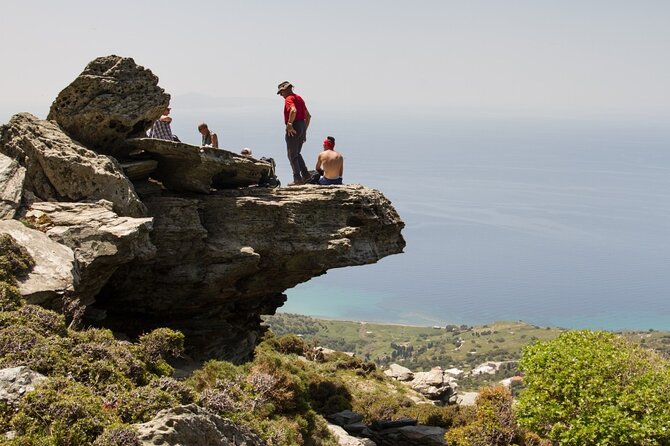
- Water in surprising places: ravines, old watermills, and the Dipotamata gorge keep Andros from feeling like a dry walk.
- Sea-finish days with swim potential: Batsi’s round bay and clear water make it easy to cool off after hiking.
- Private, group-sized feel: it’s set up for just your group, with a team that provides detailed materials.
- A practical Plan B for Apoikia seasonality: if the only hotel there is closed, you’ll adjust with a circular walk and overnight in Andros Town.
Andros Trail basics: what self-guided really means here
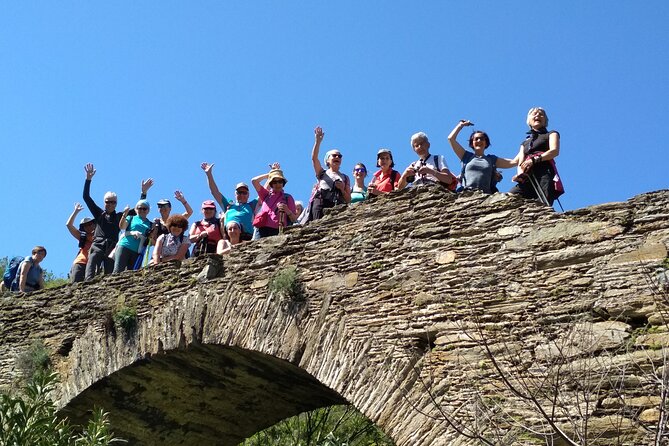
This is a self-guided trekking holiday, but it isn’t “good luck and Google maps.” You start with a walker’s pack and a team briefing when you arrive in Gavrio, then you follow a trail day by day with transfers and luggage handled for you. Think: independence with guardrails.
You also sleep inn-to-inn. Eight nights of accommodation are included, so you’re not hunting for rooms while your legs recover. Each morning starts with breakfast, which matters on hiking trips more than most people admit.
Finally, this is set for a private group. That usually makes the whole experience feel calmer and more personal, especially when you need help adjusting plans.
You can also read our reviews of more tours and experiences in Andros.
Gavrio arrival day: port pickup, check-in, and that first briefing
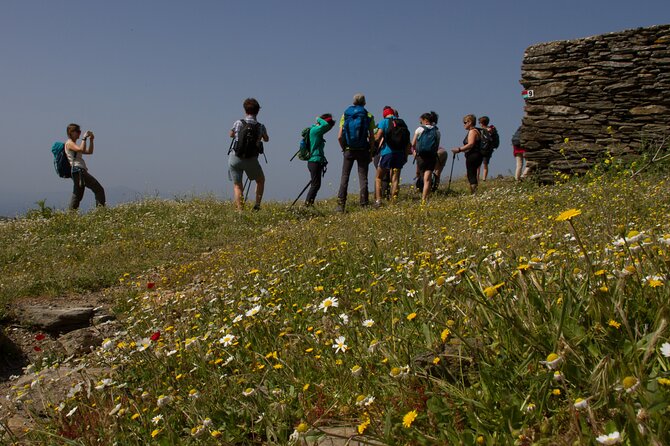
You meet at Gavrio port and get driven to your hotel. After check-in, there are welcome drinks and Greek mezes, then you meet one of the team for your self-guided documentation—your walker’s pack—plus a talk about the trails, the island, and the daily program.
This first evening sets the tone. You get your bearings without rushing, and you’re not trying to decode route notes after a travel day. If you arrive hungry and tired, the meze setup is a simple, Greek-style fix: food first, then paperwork.
Practical note: if you’re coming from another island, give yourself a little buffer. Meeting at the port usually means timing matters, and you want to be relaxed when you pick up your materials.
Day 2: Froussei Valley to Gavrio—watermills, a ravine, and a climb to ~600 m
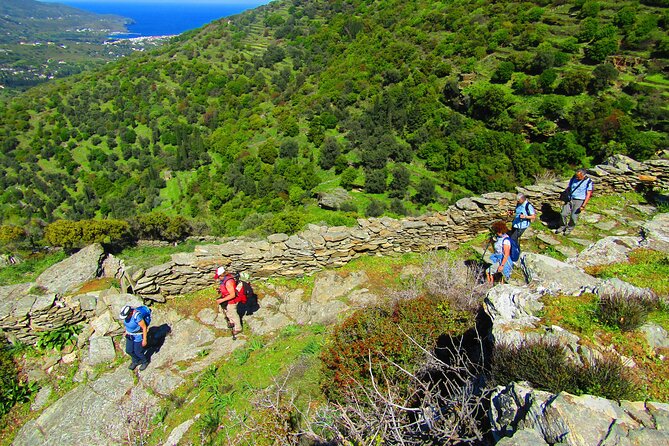
Your trekking day begins in Froussei Valley, with a walk through a unique ravine between Ammolohos and Palestou. You follow the stream past old stoned watermills, with the story of a millers’ village that operated until the mid-20th century. It’s one of those Andros contrasts that makes the island feel more layered than the typical Cyclades stereotype.
The route then ascends as you cross Ammolohos and climb toward the mountain top at around 600 m. After that, you head through high slopes with wide views back toward the port and sea, ending your first day in Gavrio.
What I like about this day: it builds confidence. You start in a dramatic setting, get history through the landscape (those watermills really do the job), and end in a town base where you can reset.
Possible consideration: this is the day where height and sun can combine. Even if you feel fine at breakfast, the climb can change how you feel by midday—start slower than you think you need.
Day 3: Agios Petros Tower to Batsi—Hellenistic power and clear bay water
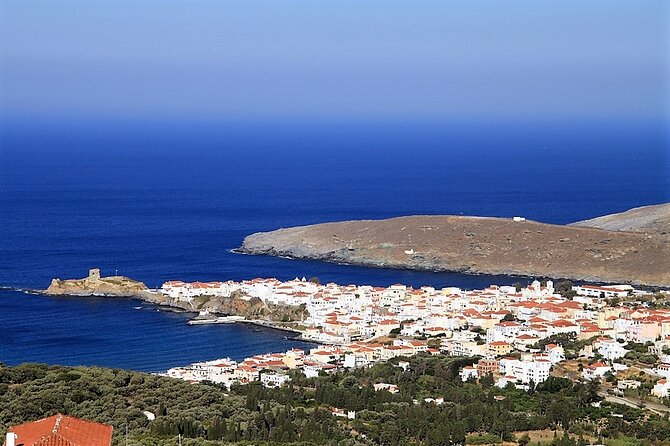
You start from Gavrio Town, and before reaching the village of the same name, you cross the Agios Petros Tower. This tower dates to the Hellenistic period (4th–3rd century BC) and is noted as one of the best-preserved in the Cyclades.
After that, the trail runs past a picturesque village and continues to the Monastery of Agia, a stop worth building time around. Then you descend toward the coast and finish in Batsi, known for its round bay and clear water.
This is a smart pairing: a stone-historic detour early, then a seaside reward at the end. It’s the kind of day where you can plan for a swim without turning it into a separate outing.
One practical tip: Batsi’s water is part of the payoff, so pack for it. If you can, bring quick-dry layers and a small towel, because cooling off after hiking is one of those simple moments that makes a trek feel like a holiday, not just exercise.
Day 4: Fardia Strada to Menites—Venetian-era route and serious elevation
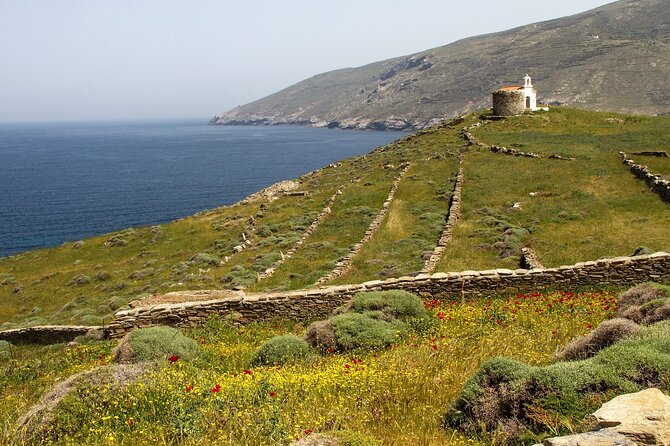
Today’s day starts with breakfast and heads out on one of Andros’s older, longer paths: the Fardia Strada, linked to Venetian times. The route leads you to Pitrofos Village, with sea views while you cross the mountain, then it ends in Menites.
This is described as a demanding walking day, and the details support that. It’s a combination of parts from the island’s route network, with varied terrain and challenging elevations. You’re not just walking the same kind of trail twice; you’re mixing up angles, footing, and scenery.
Why this works for many people: you get a sense of Andros moving through time—Venetian naming, mountain crossings, and village-to-village hiking all in one stretch. It feels like a living map.
Possible drawback: if you’re prone to overdoing it early, this is the day to stick to a pace you can repeat. Save your “faster” energy for the moments when the trail levels out.
Day 5: Panachrados Monastery area and Korthi coast—Gerakonas at 550 m
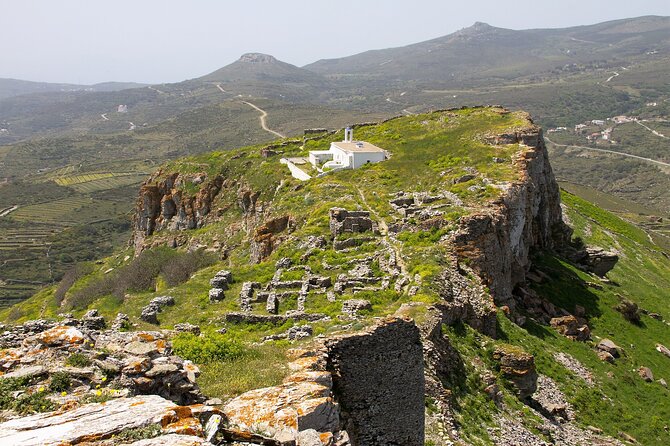
Your route combines two parts of the Andros hiking network and also includes a segment associated with the Andros Trail Race path. It takes you to Panachrados Monastery, set in the Gerakonas mountain range at about 550 m.
From there, the trail heads south along the next side of the mountain toward the picturesque Korthi area. Expect an agricultural setting with sea views as you approach the seaside finish.
This is a good “mid-trek” day because it shifts from earlier ravine and tower energy into something more rural. Monasteries tend to give you a natural pause built into the day, and the agricultural views help your brain reset from constant exertion.
Practical note: you’ll want to pay attention to where the shade is. Agriculture trails can be sun-exposed, and monastery stops are where you can take a real break—use them, don’t just pass through.
Day 6: Andros Town and the Dipotamata gorge—upper castle, arched bridge, watermills
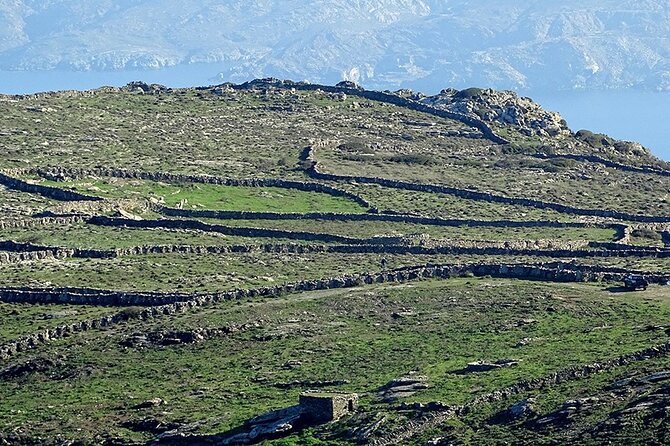
Today’s walking focuses on Andros Town and the island’s agricultural past. One of the popular route options here follows the old road that once led toward Hora, connecting two medieval castles. It was also described as the central agricultural and commercial artery for south-eastern Andros until around 1950.
As you walk, you cross highlights such as the Upper Castle, the gorge of Dipotamata with stone watermills, an arched bridge, and the village of Sineti.
What makes this day special is how packed it is with “place you can point at.” It’s not just pretty views; it’s a chain of named structures and routes that help you understand what Andros used to do—grow food, move goods, and protect strong points.
Possible consideration: since there are many distinct features, it can feel like a lot of “stopping and starting.” If you like steady walking, plan short breaks and then keep moving.
Day 7: Apoikia via Pythara ravine—shorter walk, seamanship trails, small waterfalls
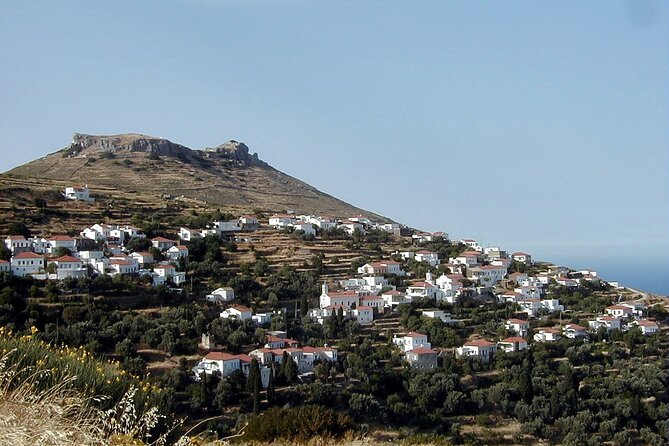
Today is described as relatively shorter. You start from Andros Town and walk toward Apoikia, following a well-preserved trail through major settlements tied to seamanship and rural Andros. The route runs up parallel to the Pythara ravine.
There’s also a detour to small waterfalls—small, but memorable if you catch them flowing. And there’s a key detail you’ll want to know ahead of time: depending on the season, Apoikia is remote, and the only hotel there may be closed. If that happens, you’ll walk a 12 km circular route and overnight in Andros Town instead.
This is where the “self-guided with support” idea really shows. You’re not stuck if a seasonal accommodation issue pops up. Instead, you get a planned adjustment built into the program.
My advice: treat this day as flexible. Keep your daypack light but include a layer and water, because even shorter routes can bring surprise detours.
Day 8: From Vourkoti to Arni valley and up to Kouvara ridge—highest views, greenest feeling
Today you head from the northeast through Apoikia toward Vourkoti, then continue to the Arni area, described as the greenest part of the island, with a forested valley. The route also takes you along the ridge of Andros’s highest point, Kouvara, for views that are the natural reward for that climb.
Even without exact mileages in the details you provided, you can infer what day 8 is about: big perspective. When a route mentions a high ridge and highest point, it usually means sustained effort up front and then a longer “take it in” phase at the end.
What I like here: Arni gives you a change from villages and coastal finishes. If you want one day in the trek that feels like a breath of shade, this is the candidate.
Practical consideration: ridge walking often means wind exposure. Pack something that handles breezes, and don’t assume that “higher” equals cooler.
Day 9: Down from Andros heights to Batsi—dense vegetation, biodiversity, and sea views
Day 9 is a descent story. You go from Andros’s highest mountain down from Arni toward Batsi, a seaside town that’s described as more cosmopolitan. The route is called one of the island’s greenest hiking days, with significant biodiversity and lots of dense vegetation.
You end at the sea with splendid views of the mountain and water. This is the day that ties a bow on the whole trek—everything you gained inland (history, shade, ridges, ravines) is now paying off as you arrive near the bay again.
My practical note: descents can be harder than climbs for your knees. If you’ve got any knee sensitivity, take shorter steps and expect slow downhills.
And since Batsi is a swim-friendly finish, this is another day where having swim gear can make the last evening feel like a proper reward, not just the end of chores.
Day 10: Departure day from Gavrio port
On your final day, everything depends on departure time. You get a transfer back to the port so you can catch your next step.
It’s a simple ending, but it matters. A trek like this can leave you tired and ready to move on, and the transfer removes one last bit of logistics stress.
Price and value: is $1,037.16 fair for what you get
At $1,037.16 per person, you’re paying for more than walking routes. You’re paying for the part that usually derails trekkers: accommodation coordination, daily breakfast, and the less-glamorous logistics of luggage transfer plus morning transfers to trail starts.
Eight nights of lodging included is the big value anchor. If you had to book each stop yourself—especially on a smaller island—costs and timing would get messy fast. Here, you’re buying continuity. That also usually improves how the trek feels day to day, because you’re not “trying to solve travel” with sore legs.
You’re also paying for setup quality. The team (Ariana and her crew) provides detailed materials and personal briefing, and the routes are set up so you can follow along without turning navigation into a second hobby. For many people, that’s what makes a self-guided holiday truly relaxing.
Who should book (and who should skip)
This trek fits you best if you want independent hiking with real structure: breakfast included, luggage handled, and trail guidance you can actually use. I’d also place it on the shortlist if you like history that’s tied to what you can see—towers, monasteries, bridges, and watermills—rather than history that lives only in museums.
You might want to rethink if you prefer flat walking or low effort days. Even the descriptions here point to climbs, mountain crossings, and demanding elevation days. Heat can also be a factor in warmer months, so plan for sun and pace.
If you’re traveling as a couple or small group and want a private setup, this style makes sense. It’s built for just your group, not a big herd approach.
Should you book this Andros Trail trek?
I’d say yes if you want a self-guided trek that still feels supported: walker’s pack, team briefing, daily breakfasts, and luggage transfer mean you spend your energy on the trail, not on logistics. The combination of ravines, old watermills, standout historic points like Agios Petros Tower, and finish days in Batsi makes it more than a “walk and repeat” holiday.
I’d book with extra caution if heat or long climbs worry you. If you’re a careful hiker with solid day-to-day mobility, you’ll likely find it a rewarding week. If you’re more comfortable with easy strolls, look for a shorter, lower-elevation alternative.
FAQ
How long is the Andros Trail trek?
The experience runs for about 10 days.
Does the trip include accommodation?
Yes. Eight nights of accommodation are included, so you don’t need to book your own places during the trekking days.
What’s included besides lodging?
You get daily breakfast, luggage transfer, transfers to the starting point of each trekking day, and a documentation pack called the walker’s pack with trail information and local recommendations.
Is this tour private?
Yes. It’s private for just you and your group.
Where do we meet, and where does it end?
You meet in Gavrio (845 01), Greece, and the experience ends back at the meeting point.
What fitness level do I need?
The trip calls for a moderate physical fitness level.
Are routes well marked and easy to follow?
You’ll receive self-guided documentation and a briefing, and the trek is described as having an organized trail approach with clear guidance.
Can I bring a service animal?
Service animals are allowed.
What if the weather is bad?
The experience requires good weather. If it’s canceled due to poor weather, you’ll be offered a different date or a full refund.
Are there any cancellation rules I should know about?
You can cancel for free up to 24 hours in advance for a full refund. If you cancel less than 24 hours before the start time, the amount paid won’t be refunded.