REVIEW · TBILISI
8-Day Trekking Group Tour in Svaneti
Book on Viator →Operated by TrekGeorgia · Bookable on Viator
Svaneti trekking hits different. This 8-day route strings together high passes, village walks, and medieval stone towers around Mestia and Ushguli, with the practical help of an expert guide team. The best part is how day hikes turn into cultural moments, not just cardio.
I especially love the small-group feel (max 15) and the way the guides keep things moving at a pace that works for most people. I also like that you get real inclusion: lodging in guesthouses, transportation, and luggage carry so you can focus on the trail.
One thing to consider: some guesthouses are simple, and you should be ready for occasional limited comforts like hot water. Also, the trek depends on good weather, so plans can shift if conditions are poor.
In This Review
- Key things I’d pin to your map before you go
- Mestia to Ushguli: Why this trek feels so specific
- Day 1 Tbilisi to Mazeri: Zugdidi and the Enguri Dam en route
- Days 2–3 Mazeri to Koruldi Lakes: Dolra River and Guli Pass
- Days 4–5 Zhabeshi to Adishi: easy trail, then higher village life
- Day 6 Chkhunderi Pass: the Adishi River horse crossing
- Day 7 Ushguli: tower churches, the ethnographic museum, and high settlement life
- Day 8 Chalaadi Glacier: a final icy stop before Tbilisi
- Price and logistics: what the $1,340 covers (and what you’ll handle)
- Who this tour suits, and what to pack for comfort
- Should you book this Svaneti trekking group tour?
- FAQ
- What time does the tour start, and where do I meet?
- How long is the trek and when does it run?
- How much hiking is involved?
- How hard is it physically?
- What lodging can I expect?
- Are meals included?
- Do I need trekking gear?
- What language will the guides speak?
- What happens if weather is bad?
Key things I’d pin to your map before you go
- Mestia to Ushguli trekking core, with medieval tower villages and church stops
- High-altitude effort on Guli Pass (2960 m) and Chkhunderi Pass (2655 m)
- Real guiding by name: Gogi, Dito, Nugo, Tato, Dimitri are praised for safety and care
- Luggage and transport support during hiking days, plus bottled water and snacks
- Guesthouse variety: private facilities some nights, shared facilities on others
- A standout moment on Day 6: a horseback river crossing for safety
Mestia to Ushguli: Why this trek feels so specific
This trek is built for people who want Svaneti to feel like a place you walk through, not a highlight reel you sprint between. You start in the mountain region with a long drive that still pays off with stops in Western Georgia, then you transition into daily hiking that ranges from easy-to-moderate trail days to two higher, harder segments.
What makes it work for me is the balance. You’re not only chasing viewpoints. You’re also moving through historic defensive tower villages and getting guided visits, including a museum in a 12th-century tower-house. That combo helps you understand what you’re seeing, instead of just taking photos and hoping it sticks.
You’ll also appreciate the built-in practicality. Your group size stays small, the guides are focused on timing and safety, and luggage transportation by car reduces the weight you have to haul all day.
You can also read our reviews of more tours and experiences in Tbilisi.
Day 1 Tbilisi to Mazeri: Zugdidi and the Enguri Dam en route
Day 1 is a big travel day, roughly 9 hours of driving, starting from the Giant Bicycle monument near Rose Revolution Square at 7:00 am. It’s not all sitting, though. You’ll break the trip with a stop in Zugdidi, where you visit Dadiani Palace tied to local rulers in Western Georgia.
Then comes the stop that surprises a lot of people: Enguri Dam, one of the highest arch dams in the world (271.5 m). The views around major infrastructure can feel unexpected when you’re thinking only about mountains, but it’s a good way to widen your sense of Georgia beyond “pretty scenery.”
After that, the drive continues into Upper Svaneti, known for preserved villages and defensive tower architecture. You end the day in Mazeri for the first night.
Possible drawback: after a long ride, your body may feel it. Plan to keep Day 2 expectations simple and treat the first hike like your rhythm-setting session.
Days 2–3 Mazeri to Koruldi Lakes: Dolra River and Guli Pass
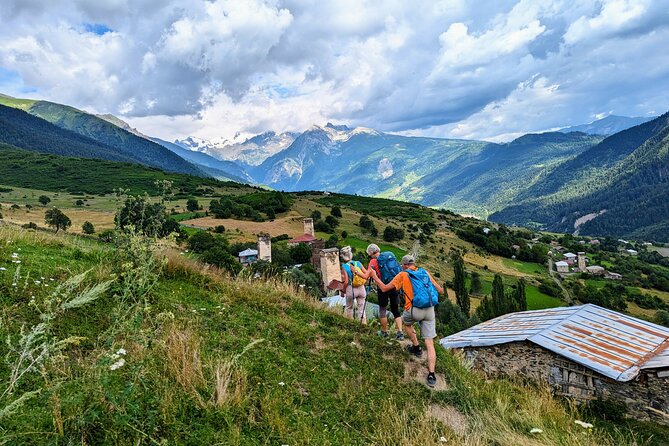
Days 2 and 3 are where the mountains start to get serious.
Day 2 from Mazeri follows the Dolra River upstream. You pass mineral water springs, a small church in a picturesque location, meadows, and then climb gradually through pine forests. You finish with a return to Mazeri. This is a helpful day because it builds confidence: you’re working, but the hike is designed to ease you into the Svaneti pattern.
Day 3 is the tougher payoff. You hike to Koruldi Lakes via Guli Pass (2960 m). You’ll need good effort for the climb, then the trail descends into a valley and opens up to the lakes. Koruldi is small, but the surrounding peaks do the heavy lifting, including views of Ushba.
Why it’s valuable: two different “feels” back-to-back. Day 2 helps you acclimate mentally. Day 3 gives you that high-pass achievement moment without forcing you into technical mountaineering.
Days 4–5 Zhabeshi to Adishi: easy trail, then higher village life
Day 4 starts the trekking proper in a more relaxed way. You hike from the area around Zhabeshi toward the Mulakhi community. The route is described as easy, following an off-road car route and staying on well-marked trails. That matters. When the trail is clear and the pace is steadier, you can actually notice details like the way villages sit below mountains and how people use the land.
Day 5 turns more scenic and more cultural. You trek toward the slopes of Tetnuldi, passing a ski resort area, then descend through birch trees and rhododendron bushes. After crossing a small mountainous river, you reach alpine meadows, and then Adishi village appears. The village is known for stone towers and older-style houses built centuries ago, tucked below Tetnuldi with a roaring river nearby.
Small consideration: Day 5 is described as 6 hours, but the terrain changes (trees to meadows to village). If you’re prone to feeling “fine until suddenly not,” pace your breaks early instead of waiting until you feel tired.
Day 6 Chkhunderi Pass: the Adishi River horse crossing
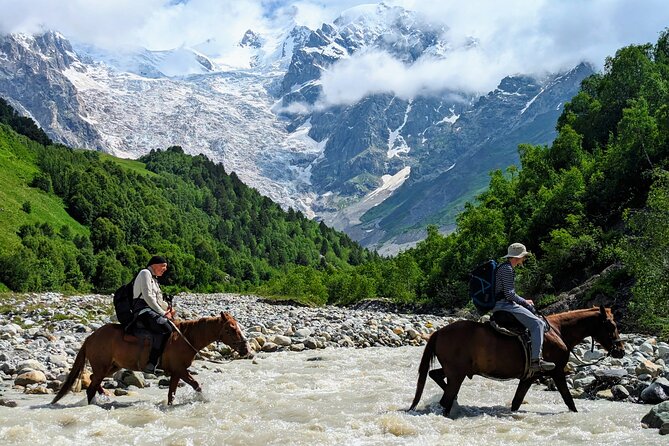
Day 6 is the day many people remember for one specific safety-focused moment: you cross the Adishi River by horseback after about an hour of walking and after fording becomes unsafe due to the river’s intensity.
Then you climb up to Chkhunderi Pass (2655 m). From the top, you get panoramic views of the Adishi Glacier area. Lunch is enjoyed on the ridge, then you descend toward the Khaldechala River valley and continue to Khalde village, which was destroyed in the 19th century by Russian soldiers. After that, the route follows an off-road to Iprali for the night.
Why this day matters: it mixes physical work, a memorable non-walk crossing, and a historical note tied to the land you’re standing on. It also gives you a clear “high point” within the trek without demanding climbing gear.
Day 7 Ushguli: tower churches, the ethnographic museum, and high settlement life
On Day 7 you move through traditional Svaneti villages, passing Kala and Davberi, then reaching Ushguli from above. Ushguli sits at the foot of Mount Shkara where the Enguri and Kvishiri rivers meet.
This is one of the best parts of the whole route because you’re walking into a living historic setting. The tour highlights Ushguli as the highest permanent settlement in Europe (2200 m), built around medieval-type towers and churches. You’ll visit the Ushguli Ethnographic Museum, located inside a 12th-century tower-house. You’ll also see the Lamaria Church dedicated to the Assumption of the Mother of God.
After the walking and visits, you don’t end the day by rushing back immediately. You overnight in Mestia, which feels like a smart buffer.
Real-life consideration: this day is shorter in hours than the high-pass day, but the altitude setting can still make you feel it. Slow down on breaks and keep water handy.
Day 8 Chalaadi Glacier: a final icy stop before Tbilisi
Day 8 is a return day: about 10 hours of driving back to Tbilisi after breakfast. On the way, you stop at Chalaadi Glacier.
You’ll follow the Mestiachala River upstream for about 1.5 km, reaching a finish point where the river is born. Even if you’ve already seen glaciers on the trek, this one is a good capstone. It helps you connect the “high snow and ice” to the water systems that shape villages and valleys.
Then it’s back to Tbilisi, and the activity ends back at the meeting point area.
Price and logistics: what the $1,340 covers (and what you’ll handle)
At $1,340 per person for an 8-day group trek, the value comes from what’s bundled. You’re not just paying for a trail. You’re paying for:
- Expert leadership from adventure guides
- Air-conditioned vehicle transport (and fuel surcharge)
- Luggage transportation by car during hiking days
- Guesthouse lodging for multiple nights (with private facilities some nights, shared facilities others)
- Water and snacks
- Most meals: breakfasts (7) and dinners (7) are included, and lunches are listed as included for 6 days, even though the notes also mention lunch as not included—so I’d confirm what’s covered on your dates.
Where you may spend extra: trekking gear. The tour notes mention you can rent trekking poles and backpacks, which helps if you’re traveling light. Alcohol isn’t included.
The other value point is risk control. With a small group and guides who prioritize safe routes, you’re less likely to waste energy second-guessing what’s next. That showed up in the guide praise—people call out punctuality and care for well-being, and they mention guides like Gogi and Dito leading with professionalism.
Who this tour suits, and what to pack for comfort
This trek suits you if you want a structured Svaneti experience with real hiking and real culture. You should have moderate physical fitness, and you’ll walk about 58 km total. You also need to be comfortable with altitude and with at least two harder sections: Guli Pass and Chkhunderi Pass.
It’s also a good fit if you like small groups. With a max of 15, it’s easier to keep the pace human and for guides to help quickly if someone needs adjustments.
Pack for comfort, not just survival:
- Trekking poles if you have them (or rent them)
- A backpack you can carry for daily needs (rentable per the tour notes)
- Layers for mountain weather shifts
- Good footwear for mixed trail and river-adjacent conditions
- A realistic expectation about guesthouses: simple and welcoming, but not hotel-standard in every stop (hot water may not be consistent)
If you’re the kind of traveler who wants one big view after another with no explanations, you might feel like the cultural stops slow you down. But if you want your photos to connect to context, this tour does a good job of that.
Should you book this Svaneti trekking group tour?
I’d book it if you want Svaneti in a way that mixes mountain effort with medieval village life, and you value guides who are focused on safety and timing. The inclusion of lodging, transport, luggage support, and most meals makes it easier to travel without turning the trip into a spreadsheet.
Don’t book it if you need consistent hotel comfort, or if you’re hoping for a trek with no altitude challenge. And don’t ignore the weather dependency. This route shines on clear days, and it’s planned around safe hiking conditions.
If your goal is to walk through Mestia-area villages toward Ushguli’s tower churches and museum, with a team like Gogi or Dito watching the details, this is a strong match.
FAQ
What time does the tour start, and where do I meet?
It starts at 7:00 am at the Giant Bicycle monument near Rose Revolution Square in Tbilisi.
How long is the trek and when does it run?
The tour runs for 8 days (approx.).
How much hiking is involved?
You’ll walk about 58 km over the course of the trek.
How hard is it physically?
It’s for travelers with moderate physical fitness, and some parts require good physical effort due to steep passes and elevation.
What lodging can I expect?
You’ll stay in guesthouses with private facilities for 2 nights each in Mazeri and Mestia, and you’ll have shared facilities for the other nights (Zhabeshi, Adishi, and Iprali).
Are meals included?
Breakfast (7) and dinners (7) are included. Lunch is listed as included for 6 days, but the notes also list lunch as not included, so confirm what’s covered for your dates.
Do I need trekking gear?
Trekking poles and backpacks can be rented, so you don’t necessarily have to bring everything, but you should still plan for basic hiking needs.
What language will the guides speak?
The tour is offered in English, and it may also be operated by a multilingual guide.
What happens if weather is bad?
This experience requires good weather. If it’s canceled due to poor weather, you’ll be offered a different date or a full refund.