REVIEW · KATHMANDU
Annapurna Circuit Trek
Book on Viator →Operated by Outfitter Nepal · Bookable on Viator
Big mountain daydreams end here, on foot. This Annapurna Circuit experience mixes guided trekking with real cultural stops: a UNESCO-style Kathmandu day before you head out, then village life and big Himalayan views on the way toward Thorung La and down into Pokhara. I especially liked how the schedule builds in breathing room in Manang, so you’re not just guessing at altitude, and you get a strong support team that handles logistics while you focus on walking.
Two things I really like: first, the pacing is built around acclimatization, including a full rest day in Manang with optional hikes and a chance to learn at the Himalayan Rescue Association aid post. Second, the operator keeps the group small (maximum 10), and the guide team approach shows up in how smoothly the days flow. One drawback to plan for: the high point is serious trekking. The pass day (Thorung La) is followed by a long, steep descent that can feel like a leg audit.
Key points at a glance
- Manang rest day built in, with optional walks for better acclimatization
- Thorung La crossing at 5,416m, plus dramatic views down the Kali Gandaki valley
- Small-group guiding with a max of 10 trekkers and structured guide support
- Lodges/tea houses each night, plus ground transport legs by bus/jeep
- Pokhara payoff includes an early start for Poon Hill sunrise views
In This Review
- Why This Annapurna Circuit Keeps Its Promise
- Price and Value: What $994 Really Buys
- Before the Trail: Kathmandu Sightseeing and the UNESCO Day
- Day 1 to Chamje: The Transit Day That Sets the Tone
- Day 2 to Dharapani: Suspension Bridges and Steep Paths
- Day 3 to Chame: Pine and Oak Forests, Village Monastery Atmosphere
- Days 4 to 6: Manang as Your Acclimatization Hub
- Day 4: Chame to Manang
- Day 5: Manang exploration day
- Day 6: Rest and acclimatization day (the one you’re glad you have)
- Days 7 and 8: Toward Yak Kharka and Thorung Phedi
- Day 9: Thorung La (5,416m) and the Long Descent to Muktinath
- Day 10: Muktinath Prayer Stop, then Jeep to Tatopani
- Day 11: Ghorepani Trek Through Villages and Rhododendron Forest
- Day 12: Poon Hill Sunrise, Then Descent Toward Pokhara
- Transportation and Group Size: The Stuff You Feel Every Day
- Guides, Safety, and Those Small Logistics Fixes
- What to Pack, and How to Carry It Without Burning Out
- Who This Trek Fits Best
- Should You Book This Annapurna Circuit Trek?
- FAQ
- What’s the meeting time for this trek?
- How long is the Annapurna Circuit trek?
- Where do you do the Kathmandu sightseeing?
- What kind of lodging do you use during the trek?
- Is airport or hotel pickup included?
- Are meals included?
- What about visas, insurance, and tips?
Why This Annapurna Circuit Keeps Its Promise
Annapurna Circuit treks can feel like a blur: wake up, walk, sleep, repeat. This one tries to keep you steady. You’ll start with a Kathmandu base that’s more than just a hotel and a goodbye dinner. Then the trekking days gradually step you up from lower valleys into the higher mountain zone, with Manang acting like your altitude “buffer.”
I also like the way this route respects the fact that the best days happen when you can actually enjoy them. There’s time to adjust, not just grind. For example, the itinerary includes a rest and acclimatization day in Manang, with optional activities instead of forcing everyone to do the same thing.
Price and Value: What $994 Really Buys
At $994 per person, you’re not just paying for the view. You’re paying for the stuff that turns chaos into a smooth trip: guide service, lodge stays during the trek, and the transportation legs that would be annoying to stitch together on your own.
Here’s what’s clearly included:
- Accommodations in lodges/tea houses during the trek
- Government taxes, VAT, and service charges
- An experienced guide
- Ground transportation on key segments (for example from Kathmandu toward Chamje, plus jeep/bus transfers such as Muktinath to Tatopani and onward toward Pokhara)
- Guide support (salary, food, drinks, accommodation, transportation, insurance)
What’s not included:
- Drinks, desserts, and any extra expenses you decide to buy
- International airfare and departure tax
- Meals while you’re in Kathmandu and Pokhara
- Nepal visa fee
- Tips for guide (and porter if you use one beyond what’s arranged)
- Travel insurance (it’s listed as required)
- If you need a porter, the data provided lists $20 per day
So the value question becomes: do you want to trade planning stress for a guided flow? If yes, this price makes sense for a trek that’s typically logistics-heavy.
You can also read our reviews of more tours and experiences in Kathmandu.
Before the Trail: Kathmandu Sightseeing and the UNESCO Day
You’ll get a full day in Kathmandu for sightseeing of UNESCO-listed attractions. The operator also mentions private vehicle support for the Kathmandu sightseeing. That matters because Kathmandu traffic can turn a simple plan into a long, sweaty guessing game.
In practical terms, this day helps you in two ways:
- You get your bearings in a city that can be confusing at first.
- It turns the trek start into something smoother. You’re not flying in, checking into a hotel, and launching into trekking the next morning without time to orient.
Also, pickup is offered. The trip lists airport or hotel pickup, with the trek departure logistics tied to an early meeting time.
Day 1 to Chamje: The Transit Day That Sets the Tone
Your trek starts after a morning push. The meeting point start time is 6:15 am, and the day-by-day notes also mention pickup around 7:00 am. Expect early. This is normal for mountain travel.
You’ll head to the bus terminal, ride to Besisahar, then take a local jeep to Chamje, your first overnight stop. This is a “settling in” day: road time, river views, and a slow shift from city noise to valley air.
Two practical notes:
- Have breakfast before the morning launch. It’s time-sensitive.
- Bring layers for the ride. Morning can feel cool even when the afternoon sun is strong.
Day 2 to Dharapani: Suspension Bridges and Steep Paths
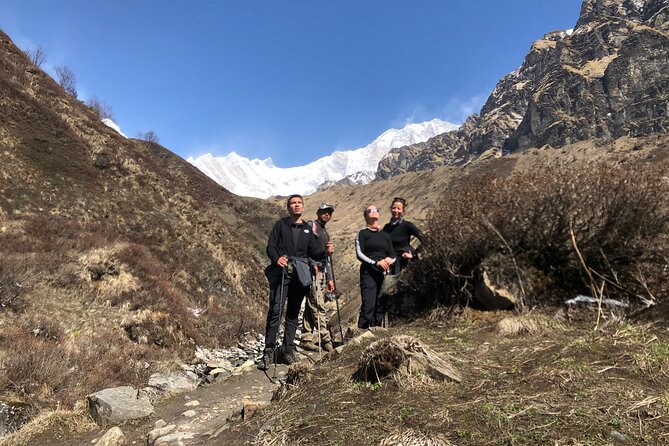
Day 2 is where the trail starts showing its teeth. You begin with descending to the river and crossing another suspension bridge. Then you climb hard to Sattale (1,550m) on a steep path where one slip would be a big deal—so you’ll walk with care, not bravado.
From there, you move along an undulating route above the river, with sections that can feel carved into the rock itself. You’ll reach Tal (1,700m) and continue toward Karte (1,900m), before settling into the overnight rhythm.
Why this day matters: it teaches you trail technique for the rest of the trip. Short steps, steady pacing, and good foot placement will do more than trying to race the climb.
Day 3 to Chame: Pine and Oak Forests, Village Monastery Atmosphere
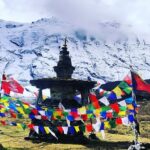
On Day 3, you trek through narrow fields near the Dudh Khola, then follow the Marsyangdi River. You’ll pass zones where Manaslu is referenced as a source for the river system, and later you’ll see Buddhist touches in the Bhote village area, including prayer flags around a monastery setting near Bagarchhap.
You’ll climb through forests of pine and oak, then continue via stops including Danaque (2,210m) and Timang, before reaching Chame for the night.
This day feels like a transition from valley travel to proper mountain walking. The air starts to feel different, and the forest scenery makes the climbs feel less monotonous.
Days 4 to 6: Manang as Your Acclimatization Hub
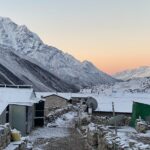
Manang is your main base for altitude management. The itinerary spends multiple days here: walking in, then a full rest day, then a higher push toward Yak Kharka (4,000m area).
Day 4: Chame to Manang
You set off toward Pisang and climb into higher rocky areas. There are sections where the opposite bank becomes cliff-like, so the trail stays dramatic and tight. You’ll reach Bhratang (2,950m) and then continue onward before arriving in Manang.
Day 5: Manang exploration day
This day is listed as a trek that includes views over the Manang valley and peaks referenced such as Tilicho Peak (listed as 7,145m). You’ll pass by Humde (3,320m) and continue along the broader valley plains toward Mungji, with cultivated fields and village sights such as Braga referenced.
Day 6: Rest and acclimatization day (the one you’re glad you have)
You’ll stay in Manang and get options:
- Day walks to see the icefall area coming down from the Annapurnas
- A hike higher above the village for wide panorama views
- A visit to a Himalayan Rescue Association (HRA) aid post, framed as an educational stop
- A visit to Ganagapurna Glacier Lake
This is the day that can turn a hard trek into a doable one. Your body learns. You don’t just push up to higher altitude and hope.
Days 7 and 8: Toward Yak Kharka and Thorung Phedi
From Manang, Day 7 rises gently but steadily into higher country through Gunsang (3,960m) and on to Yak Kharka. It can feel like a short trek because you’re not sprinting, but the air gets thinner as you climb.
Day 8 continues the setup for the big crossing:
- You ascend to a ridge, then descend toward the headwaters of the Marsyangdi
- You cross via a covered wooden bridge
- You move across an unstable slope section before descending to Thorung Phedi, where you overnight
This is the “get ready for the pass” stage. If you want to do well at the top, focus on sleep, hydration, and not overdoing extra side routes.
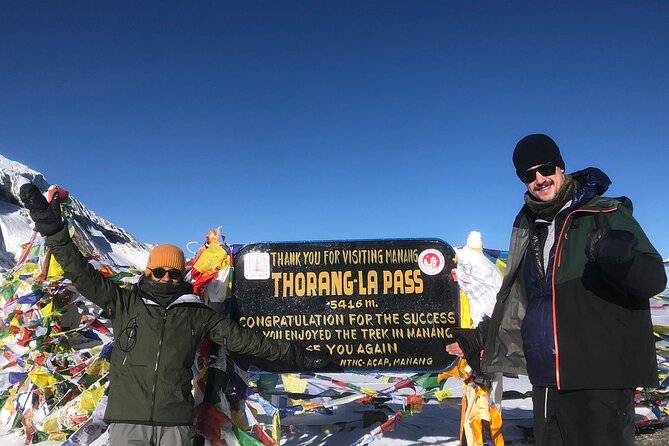
Day 9: Thorung La (5,416m) and the Long Descent to Muktinath
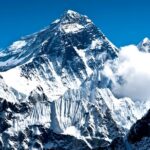
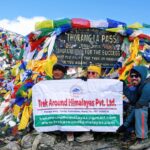
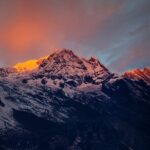
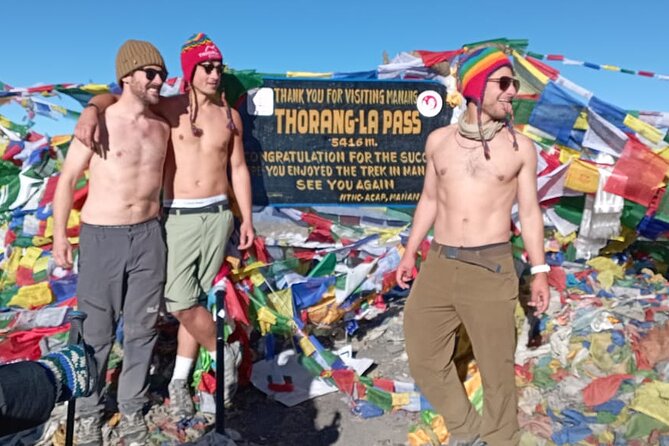
This is the main event day. You start early and cross Thorung La (5,416m). The trail becomes steep right away, but it’s described as well-defined since locals have used it for centuries. After about four hours of steady climbing, you reach the pass area with chortens and prayer flags.
The views are described as intense:
- Snow-covered mountains above
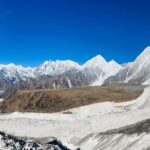
- The head of the Kali Gandaki valley
- Brown and purple hills of Mustang spread out before you
- Dhaulagiri also appears prominently during the descent phase
Then comes the part that many people feel in their knees: the descent to Muktinath is described as knee pounding, about 1,600m of descent. That’s the one day where you’ll want your downhill technique to be automatic. Short steps, plant carefully, and keep your pack balanced.
Day 10: Muktinath Prayer Stop, then Jeep to Tatopani
After getting up and freshening, you head to Muktinath to pray for yourself and others. Then you return to your lodge for breakfast, pack up, and take a jeep ride from Muktinath to Tatopani along the Kali Gandaki River.
Two nice things about this day:
- It breaks the walking monotony with a transport leg.
- It gives you a recovery rhythm after the pass day’s effort.
Day 11: Ghorepani Trek Through Villages and Rhododendron Forest
Day 11 heads into the classic “pre-sunrise region” hiking. You’ll pass flat ground, then a steep ascent for at least an hour. After that, you walk through villages (Phalate, Chitre are named) and move through rhododendron forests.
Wildlife is mentioned too (monkeys and birds). You’ll also have panoramic views of different mountains as you go.
You end the day at Ghorepani for overnight at a lodge.
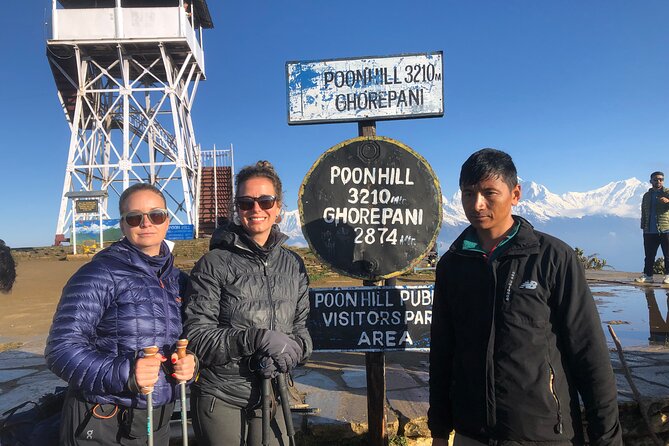
Day 12: Poon Hill Sunrise, Then Descent Toward Pokhara
This day starts early again. You take an early morning trip to Poon Hill (3,232m) for sunrise views. The itinerary lists a long set of peaks you might be able to see from there, including:
- Dhaulagiri (8,167m)
- Annapurna I and South (listed as 8,091m and 7,219m)
- Machhapuchhre (listed as 6,993m)
- Multiple Annapurna peaks (II, III, IV) and others like Lamjung Himal
After sunrise, you return to the lodge for breakfast. Then you begin a gradual descent through forests of rhododendron and oak toward Banthanti, a small village where you can pause for hot and cold drinks. The route continues onward toward Ulleri and then on to Pokhara.
This day is the payoff. It’s also a reminder that the trek doesn’t just end at the highest pass. Your legs keep working until the city reward.
Transportation and Group Size: The Stuff You Feel Every Day
This trek runs with a group size of up to 10 travelers. The operator’s added notes say one guide typically covers up to 10 people, with additional guides and porters if numbers go higher. In other words, you should expect hands-on support rather than a “you’re on your own” vibe.
Also pay attention to transport style:
- Private vehicle support is mentioned for airport transfers and Kathmandu sightseeing
- You’ll use bus or jeep legs on the trek route itself
- The operator notes tourist bus transportation from Kathmandu to Pokhara and return
I like this mix because it reduces fatigue from too much car time, but still keeps key transfers from becoming a daily headache.
Guides, Safety, and Those Small Logistics Fixes
The guide team names showing up again and again include people like Balaram Khadka (Bala), Ram, Amar, Jitu, Kapil, Indra, and Hom. Across these names, the common thread is clear: the team focuses on keeping things running smoothly and making sure you stay safe.
One practical example from the operator’s pattern: when gear problems come up, the team doesn’t just shrug. There’s at least one story of a guide helping with shoe repair by taking shoes to a workshop area. That kind of problem-solving matters more than fancy promises.
What to Pack, and How to Carry It Without Burning Out
This trek uses the classic “carry a day pack, let porters handle the main load” style.
You’re told to carry a day pack with essentials such as:
- water bottle
- camera
- sunscreen
- spare jacket
- and basic trek items
Your main luggage is meant to ride with the porter. The operator notes a porter carries about 20 kg total, with the split described as roughly 10 kg per trekker.
Also useful: there’s mention of leaving non-trek clothes in Kathmandu or Pokhara in a locker/safe deposit setup at no charge. That keeps your trekking bag lighter and your transition back to the cities smoother.
Who This Trek Fits Best
You’ll be happiest on this trek if you:
- want a guided route with steady logistics and small-group attention
- like a trekking pace that includes acclimatization time (especially Manang)
- are okay with altitude and early starts
- want a strong mix of culture (Kathmandu) and mountain walking (Thorung La region) plus a scenic finish (Poon Hill)
If you’re new to trekking, this is still possible, but treat it as a training opportunity. You’ll need to take pace and downhill technique seriously.
Should You Book This Annapurna Circuit Trek?
I’d book it if you want a classic circuit experience but prefer not to fight details. The Manang rest day, the structured transfer legs, and the small-group guiding approach are the kind of “boring” advantages that make the trek more enjoyable.
I’d think twice if you’re chasing an easy hike. The Thorung La pass day and the heavy descent to Muktinath are not casual. You’ll earn the views, but your knees will know you did it.
If you’re mentally ready for that trade, and you want a well-supported, lodge-based trekking plan from Kathmandu through Pokhara, this one is a solid bet.
FAQ
What’s the meeting time for this trek?
The meeting point start time is listed as 6:15 am. The first day pickup is described as around 7:00 am from your hotel.
How long is the Annapurna Circuit trek?
The duration is listed as 12 days (approx.).
Where do you do the Kathmandu sightseeing?
You’ll have a full day of pre-hike sightseeing in Kathmandu covering UNESCO-listed attractions, with private vehicle support mentioned for the sightseeing.
What kind of lodging do you use during the trek?
You stay in lodges/tea houses during the trek, with accommodations included.
Is airport or hotel pickup included?
Pickup is offered, and the package notes airport or hotel pickup along with comfortable transfers.
Are meals included?
Lodging is included, and the package lists some included meals during the trek (dinner, lunch, breakfast tied to specific days). Meals in Kathmandu and Pokhara are not included.
What about visas, insurance, and tips?
Nepal entry visa fees are not included, and you can issue the visa on arrival with 2 passport size photos. Travel insurance is listed as compulsory, and tips for the guide & porter are not included.