REVIEW · KATHMANDU
10 Days Private Annapurna Base Camp Trek
Book on Viator →Operated by View Nepal Treks and Expedition · Bookable on Viator
Ten days, and your legs earn their views. This private trek in Nepal pairs real village life with the big payoff of reaching Annapurna Base Camp, walking along the Modi River and through lush forests that gradually give way to sanctuary-style alpine terrain. I love how much variety you get in just a week—Gurung culture in places like Ghandruk and Chomrong, then bamboo and rhododendron forests later—and I love the way the route keeps pulling you deeper upstream toward the sanctuary, with multiple mountain peaks showing up as you go. The main drawback to plan for is the physical side: even though it’s listed as moderate, you still face stone steps, repeated up-and-downs, and at least one steeper push near the end of the trek.
This is also the kind of organized trip that feels built for walking days. You’ll travel with a licensed guide and a porter (set up as 2 clients to 1 porter), your trekking meals are handled, and you get private transport for the key non-walking legs between Kathmandu, Pokhara, and trail start points. In the feedback I saw, guides like Kumar and Sukman stood out for being supportive, adjusting to your pace, and keeping things positive even when the trail asks for effort.
One more thing to keep in mind: this experience requires good weather. If conditions aren’t right, plans can change, including the chance to take an alternative date or a full refund—so don’t treat it like a guaranteed snow-globe moment.
In This Review
- Quick reasons this Annapurna Base Camp trek feels worth it
- Kathmandu to Pokhara: river driving before your feet hit trail
- Ghandruk and Chomrong: Gurung villages, museum stops, and the gateway feeling
- Himalaya Hotel to Bamboo: forested Modi River gorges and altitude-ish changes in mood
- Annapurna Base Camp day: the sanctuary feeling and the glacier payoff
- The return loop: Deurali to Bamboo, then down with purpose
- Landruk to Dhampus: suspension bridge time and the best finish views
- Price and logistics: does $1,100 per person feel fair?
- The real hero: your guide (and how the company handles your pace)
- Weather dependence and the one thing you cannot control
- Should you book this Annapurna Base Camp trek?
- FAQ
- Where does the trek start and end?
- How long is the Annapurna Base Camp trek?
- What is the price per person?
- Is pickup included?
- Is this a private tour?
- What’s included in the trek package?
- What is not included?
- How do you return to Kathmandu at the end?
- What fitness level do you need?
- What happens if weather is poor or the minimum number of travelers isn’t met?
Quick reasons this Annapurna Base Camp trek feels worth it
- Private trekking setup with a guide and a porter for a smoother day-by-day experience
- Modi River walking through gorge-like terrain, with scenery that shifts as altitude and vegetation change
- Gurung village stops like Ghandruk and Chomrong, with culture woven into the route
- A real Base Camp day plus time in the Annapurna Sanctuary with big glacier views
- Hot springs on the return at Jhinu Danda, plus classic downhill recovery time toward Pokhara
Kathmandu to Pokhara: river driving before your feet hit trail
You start in Kathmandu and drive to Pokhara, with a long-ish transfer that doubles as your first mountain-view warmup. On the way, you pass local villages and get views of hills and peaks, plus you’ll notice the Trisuli and Marsyangdi river along the route. It’s not just transit. It helps you switch from city pace to “Nepal pace,” where the day is measured in scenic stops and steady progress.
This day is about setting your rhythm. You’ll spend roughly 6 hours driving, then sleep overnight in Pokhara before your trek starts. It’s a nice way to keep the first day from feeling like a total grind, especially if you arrive in Nepal tired and need a soft landing.
You can also read our reviews of more tours and experiences in Kathmandu.
Ghandruk and Chomrong: Gurung villages, museum stops, and the gateway feeling
The trek proper begins after breakfast in Pokhara. Day 2 is a drive out beyond the Pokhara valley, past farm villages and towns, and then you work your way into the Annapurna region along the Modi River corridor. Your first walking segment is described as flatter and easier: you’ll walk along the river to Syauli Bazaar and then deal with stone paved steps up toward Kimche and onward to Ghandruk.
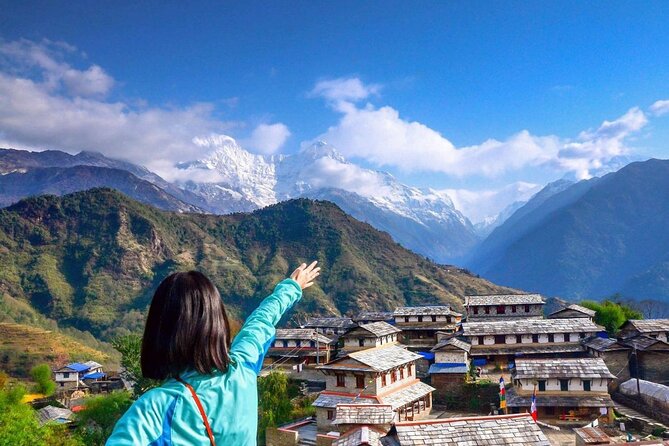
What I like here is the mix. You’re not just trekking through scenery—you’re walking through a human landscape. Ghandruk is a highlight: you get strong views of Annapurna South, Hiunchuli, and Fishtail, and you can visit the Gurung village and a local Gurung museum. The ACAP headquarter is also mentioned in the stop, which matters because it gives you more context for why this area is managed the way it is.
Day 3 shifts to the Chomrong direction. It’s a shorter day in time on paper, but it still includes a sequence of down to river areas and then up again through villages such as Kyomrong and Chomro. You end in Chomrong, described as the last permanent Gurung village and a gateway into the Annapurna Sanctuary and Base Camp trekking. That “gateway” feeling is real in this kind of route: once you reach Chomrong, you’re no longer in the broad foothills world. You’re starting to move toward the tighter sanctuary terrain.
A quick consideration: this is where you’ll learn your own walking rhythm fast. Even when the itinerary calls a day “short,” your legs will feel it because the route uses repeated elevation changes and village-to-trail stair-like sections.
Himalaya Hotel to Bamboo: forested Modi River gorges and altitude-ish changes in mood
On Day 4, you start by going downhill through terraced farm fields to the Chomrong river and then cross a bridge before heading up toward Sinuwa-Danda. From there, the trail turns into something many people love about the Annapurna region: dense forest. You move through bamboo, rhododendron, and oak forest toward Bamboo, where lodges cluster to support trekkers.
This is also the night where Himalaya Hotel comes into the story. The itinerary says this lodge is in the middle of the forest Modi River gorge. That setting changes your whole experience. Instead of open village views, you’re living inside the soundscape of a river and trees. If you like trekking days that feel enclosed and atmospheric, this is a strong pick.
Day 5 continues the climb-in spirit, even though the timing is listed as about 6 hours. You’re moving from the forested world into sanctuary terrain, where vegetation and tree lines drop and you see higher altitude alpine bushes and shrubs. The route follows upstream along the raging Modi River, and the day builds toward the Base Camp approach.
Annapurna Base Camp day: the sanctuary feeling and the glacier payoff
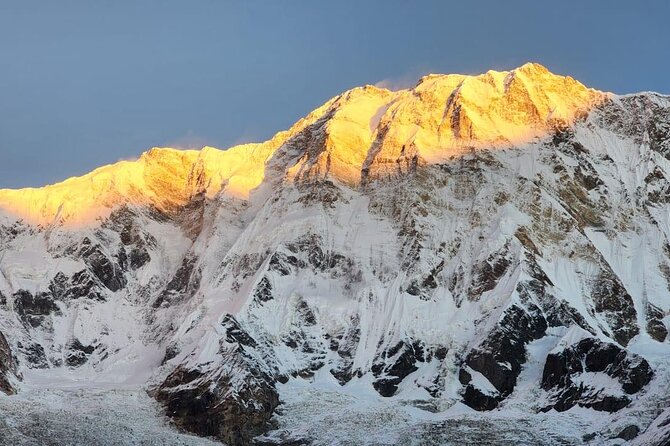
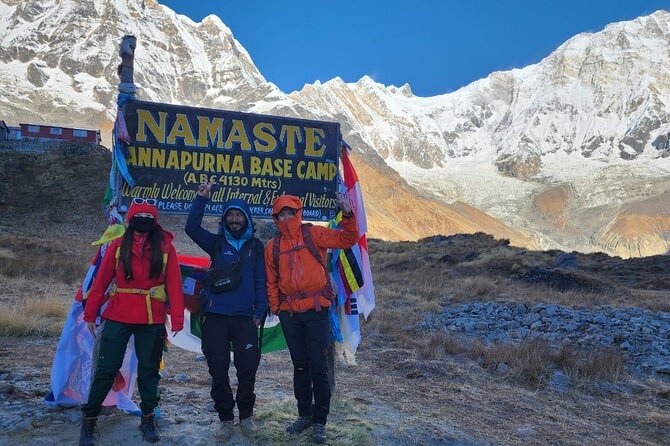
Day 5 is the big one. After time at the sanctuary and trekking onward past Machhapuchare Base Camp, you finally push into the main destination at Annapurna Base Camp. The route includes a last steep climb to reach Machhapuchare Base Camp, then a short walk to get to Annapurna Base Camp itself.
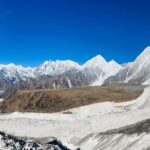
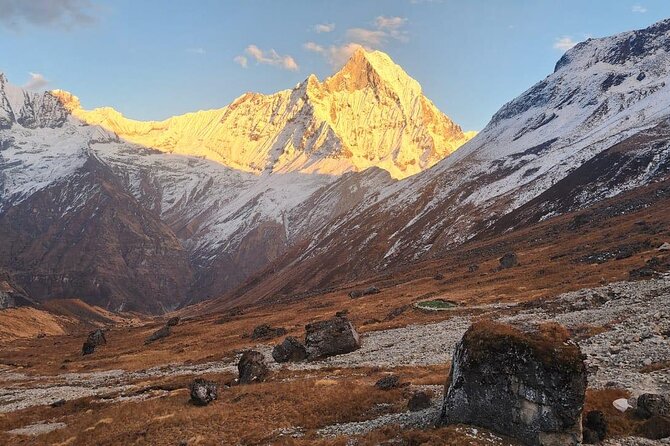
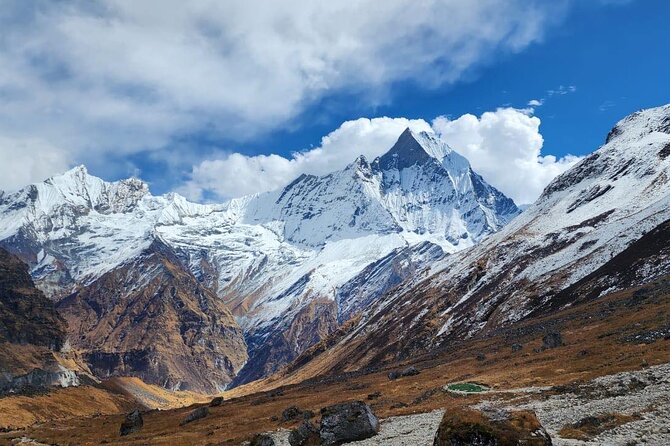
Here’s what makes it special: you’re not just arriving at a spot. You’re walking into a wall of peaks. The description calls out huge views of the Annapurna glacier and the surrounding valley filled with white mountains, including Annapurna I, III, South, and Fishtail. Even if weather limits visibility sometimes, this part of the trek is designed for dramatic geometry—big ridgelines, sharp angles, and the sense that you’ve entered a different world.
Also, the itinerary suggests that the views get better as you approach Base Camp inside the sanctuary. So plan your energy for the final climb. If you go into that push too fast, you’ll pay later. If you go in controlled, the payoff feels fair.
The return loop: Deurali to Bamboo, then down with purpose
After Base Camp, Day 6 is long downhill walking with a few short ups and downs. You descend to Deurali past Machhapuchare Base Camp, then continue back through winding trail back into green forested areas to Bamboo. The key on the return days is that your body is learning the new math: the legs might be tired, but your pace can be calmer because you’re heading down and moving in and out of forest.
Day 7 keeps the loop going. You climb from Bamboo to Khuldi Ghar, then descend into dense forest back to Sinuwa-Danda and continue down toward Chomrong Khola. There’s an uphill segment to Chomrong village for a rest or lunch stop, then another short up to Chomrong ridge before descending to Jhinu-Danda for the night.
This is where your trek gets a little reward built in. The itinerary notes hot springs at Jhinu Danda, about 20 minutes’ walk downhill near the Modi River. If you like the idea of earning recovery, this is one of the most practical and enjoyable moments on the entire trip.
Landruk to Dhampus: suspension bridge time and the best finish views
Day 8 is a long descent all the way toward the Modi River. You’ll cross a long suspension bridge and then pass farm fields before climbing briefly to reach Landruk. After that, the route continues with gentle winding walks to Tolka, with views called out for Annapurna South and Huinchuli.
Day 9 is a travel-day disguised as a trekking day. It starts from Tolka on a gradual trail with a few short ups and downs and heads into cool forest to reach Deurali. From Deurali, the views get a good spread: Dhaulagiri, Annapurna South, Huinchuli, and Machhapuchare are all mentioned, plus the possibility of seeing Ghandruk village. Then the day turns back downhill via forest areas to Pothana, ending with a scenic ridge stop at Dhampus.
Dhampus is your big panoramic finish point before the final descent. The itinerary calls out a panorama of Annapurna-Manaslu-Lamjung with Machhapuchare. After that, you walk downhill to Phedi and then take a short drive (about half an hour) back to Pokhara.
Day 10 is your exit from the region. You’ll fly back to Kathmandu or take a tourist bus in the morning and arrive in the afternoon, then have time for final shopping and a relaxed evening.
Price and logistics: does $1,100 per person feel fair?
At $1,100 per person for about 10 days, you’re paying for a private setup that includes the hard-to-organize parts: guides and porter support, trekking meals, trekking accommodation, key transportation legs, and the required trekking paperwork. This is not a bare-bones backpacker-only cost.
Here’s what’s included:
- Guide and porter (license holder guide + porter; set for 2 clients:1 porter)
- Meals: breakfast, lunch, and dinner on the trekking days (breakfast count is listed as 8, lunch as 8, dinner as 7)
- Accommodation: trekking lodging plus 2 nights of rooms in the Pokhara area via private transport legs (Pokhara and Phedi-Pokhara are referenced, with Nayapul mentioned as part of the setup)
- Permits: trekking permit and TIMS card
- Guide/porter insurance plus guide salary and transport are included as well
What’s not included:
- Drinks, grocery items, and tips for guide and porter
- If you need an extra night in Kathmandu, it’s listed as $40 USD per night
Value verdict: the biggest “yes” is the guided, porter-supported structure. If you’ve ever tried to build an Annapurna trek yourself, you know the paperwork and coordination can be a headache. This price also makes sense when you factor in meals and lodging being handled during your walking days.
If you’re someone who prefers full control and minimal spending on logistics, you might feel this is more than you’d want. But for most people who want a well-run trek without constant planning, $1,100 is a reasonable trade.
The real hero: your guide (and how the company handles your pace)
The trek description is straightforward, but the success of this kind of mountain hike usually comes down to the human system behind it. In the feedback I saw, guide Kumar got repeated praise for being funny, knowledgeable, and genuinely helpful. Sukman was also highlighted as warm and responsible, with an emphasis on adapting to the walker’s level. Pande and Koumar were mentioned as professional and considerate as well.
What you should expect to feel: when you’re tired, your guide should help you manage it. The info provided here supports that approach—there’s an explicit note that the route can be adapted to your level, and the presence of a porter means you can keep your energy for the walking.
One caution: private doesn’t mean effortless. It means you don’t share your group with strangers. You still need to show up with moderate physical fitness and be ready for some steeper sections.
Weather dependence and the one thing you cannot control
This trek requires good weather. That’s not small talk. Mountain visibility can change quickly, and the itinerary includes a scenic flight option back to Kathmandu, which also depends on conditions.
So I recommend traveling with flexibility in mind. If you’re scheduling your entire Nepal trip down to the hour, you’ll feel more stress than you need. If you can give yourself a buffer day or two around the trekking dates, you’ll handle weather changes with less drama.
Should you book this Annapurna Base Camp trek?
I’d book it if you want a private Annapurna Base Camp experience that mixes culture, river gorges, and the real sanctuary payoff—with most of the practical stuff handled: permits, meals, lodging, and guide/porter support. It’s a good fit if you like walking through villages like Ghandruk and Chomrong, then shifting into forested Modi River terrain before reaching the glacier views at Base Camp.
I’d think twice if you want a totally easy stroll. Even with moderate fitness guidance, the route includes steps, a steeper push late in the trek, and a lot of up-and-down work across multiple days. Also, if weather rigidity would ruin your trip, plan your Nepal dates with extra breathing room.
FAQ
Where does the trek start and end?
It starts at View Nepal Treks & Expedition P. Ltd. on Thamel Marg 24, Kathmandu 44600, Nepal, and it ends back at the same meeting point.
How long is the Annapurna Base Camp trek?
The duration is about 10 days.
What is the price per person?
The price is listed as $1,100.00 per person.
Is pickup included?
Pickup is offered.
Is this a private tour?
Yes. It’s a private tour/activity, and only your group will participate.
What’s included in the trek package?
Included are a licensed guide and porter (2 clients:1 porter), breakfast, lunch, and dinner during the trek days, trekking accommodation, 2 night rooms in the Pokhara area by private transport, and permits including a TIMS card. Guide, food, salary, transport, and insurance are also included.
What is not included?
Not included are drinks, grocery items, and tips for the guide and porter. If you need accommodation in Kathmandu, it costs $40 USD extra per night.
How do you return to Kathmandu at the end?
On the final day, you can take a scenic flight back to Kathmandu or a tourist bus in the morning and arrive in the afternoon.
What fitness level do you need?
The information states travelers should have a moderate physical fitness level.
What happens if weather is poor or the minimum number of travelers isn’t met?
The experience requires good weather. If it’s canceled due to poor weather, you’ll be offered a different date or a full refund. If the minimum number of travelers isn’t met, you’ll also be offered a different date/experience or a full refund.
If you want, tell me your walking comfort level (daily hills vs. flat walking), and I’ll help you judge whether this 10-day routing looks like a good match.