REVIEW · KATHMANDU
Tsum Valley and Manaslu Trek
Book on Viator →Operated by Accessible Adventure Pvt. Ltd · Bookable on Viator
Tsum Valley feels like Nepal unplugged. This 21-day trek pairs the quiet Tsum Valley (used to be restricted) with the big scenic payoff of the Manaslu Circuit, from monasteries and hamlets to high passes like Larkya La. You’ll get a guided, organized route that also leaves room for real village encounters.
I love how the trek is built around places with meaning, not just photo stops. You spend real time near Mu Gompa and Rachen Gompa, plus you pass through a culture shaped by Tibetan Buddhism and local traditions that still feel separate from mainstream Nepal. I also like the practical support: down jacket and sleeping bag use, plus transport and permits handled for you.
One drawback to plan for: the days are long and steep at times, and there’s no hot shower during the trek. If you hate early starts or you’re easily discouraged on slippery mountain trails, this route can feel tough—though it’s manageable with the right pace.
In This Review
- Key highlights you should care about
- Tsum Valley and Manaslu: why this combo works
- Kathmandu warm-up: Durbar Square, Swayambhunath, and permit prep
- Into the gorges: Macha Khola, Tatopani, and the Jagat check post
- Entering restricted Tsum Valley: Salleri, Siridibas, Lokpa, and the checkpoints
- Chumling and the Tsum community school: Tibetan Buddhist life on foot
- Mu Gompa to Rachen Gompa: monastery days with monks and nuns
- Leaving Tsum for Manaslu at Deng: the “big trek” begins
- Sama, Samdo, and the pass route preparation
- Larkya La and Karcha La: the serious walking days
- Gear, comfort, and what’s actually included
- Price and value: is $1,495 worth it?
- Who should book this trek, and who should rethink it
- Should you book this Tsum Valley and Manaslu trek?
- FAQ
- What is the duration of the trek?
- Where does the tour start and when?
- How many nights do you stay in Kathmandu?
- Are trekking permits included?
- Do they provide trekking gear like a sleeping bag?
- What accommodation style do you get during the trek?
- Is pickup included?
- Who handles the trek logistics and do you get porters?
- Is lunch and dinner included?
- Is there free cancellation?
Key highlights you should care about
- Restricted Tsum Valley access with permit checkpoints that you’ll see up close as you enter
- Guides and support people with real credibility, including Mahendra and porter Ratskumar (as shared in past trip experiences)
- Tibetan-Buddhist sites in daily walking rhythm, not saved for one dramatic “big day”
- Hot-spring reset and suspension-bridge crossing moments that break up the trekking grind
- Larkya La as the serious high point, with majestic views and careful footwork needed
- Small group size (max 15), which usually means less crowd noise in villages
Tsum Valley and Manaslu: why this combo works
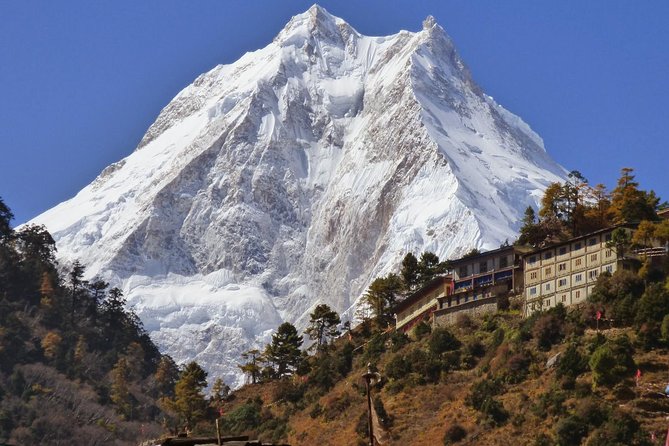
This trek works because it gives you two different kinds of satisfaction. In Tsum Valley, you’re moving through a region that stayed quieter for years, where villages, gompas (monasteries), and mani walls feel like everyday life. On the Manaslu Circuit, you shift to wider mountain scale: glaciers, passes, and that classic Himalaya sense of distance.
And the order matters. You start with cultural and physical ramp-up in the Tsum area—river crossings, climbs, monastery visits—before you hit the main Manaslu rhythm. By the time you reach the high passes, you’re not starting from zero, even if some days still feel demanding.
You also get a clear “story” to your walking. It’s not only altitude gain; it’s culture-to-culture-to-views. You’ll notice that as you move from places like Lokpa and Chumling toward Samagaon, Sama, Samdo, and the Larkya La route.
You can also read our reviews of more tours and experiences in Kathmandu.
Kathmandu warm-up: Durbar Square, Swayambhunath, and permit prep
You’ll begin in Kathmandu with a smooth arrival setup. After landing at Tribhuvan International Airport, you’re driven to a 3-star hotel in Thamel, about 5 km away. After you settle, you can keep it simple: stroll nearby streets and get your first real meal in Nepal.
Day 2 is your “get ready and get grounded” day. You meet the team and take care of your trek permits and documents before doing some high-value sightseeing. Kathmandu Durbar Square at Basantapur is on the list first, and it’s often nicknamed Freak Street—useful if you want an easy way to understand the old-city vibe without overthinking it.
Then you head to Swayambhunath stupa for panoramic city views and strong Buddhist and Hindu pilgrim energy. You also visit Pashupatinath Temple on the northern side, famous for worship of Lord Shiva. If you arrive tired, this is still worth doing because it’s compact and varied. Temple time helps you shake off travel stiffness before the walking starts.
Into the gorges: Macha Khola, Tatopani, and the Jagat check post
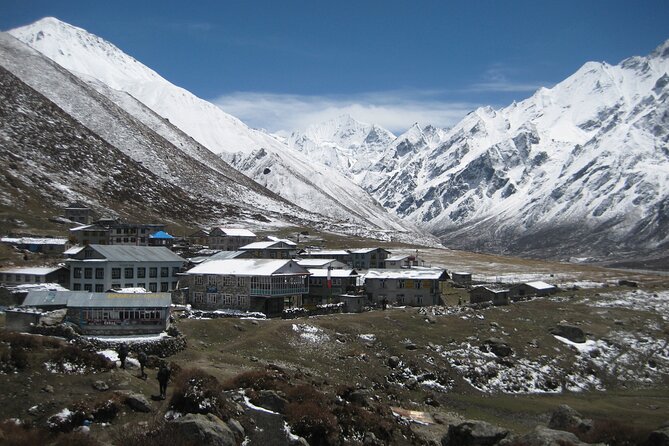
The trekking rhythm begins with a drive out of Kathmandu and into the river-and-gorge world. You’ll drive to Macha Khola on day 3, with paved roads for the first stretch and rougher road surface later. It’s not a long day of walking, but it matters because it positions you right where the trail becomes a staircase of valleys.
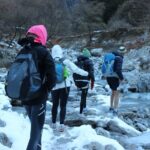
Day 4 turns physical in a smart way. You follow the river gorge, walk a narrow trail up and down, cross the Tharo Khola, and keep going toward Tatopani, where you can soak in natural hot springs. This is one of those rare trekking moments that gives you immediate payback: sore muscles get a break, and you keep momentum without feeling like you lost a day.
From Tatopani you cross suspension bridges—including one over the river and another over the Yaru Khola—and climb stone steps toward Tharo Bharyang. Then you crest the ridge and reach Jagat, where you show trekking permits at a check post because beyond Jagat is restricted.
Expect some village wandering, but the main point of day 4 is transition. You go from river-valley travel into the zone where permits start controlling the movement—so you’ll feel the trek tightening around you.
Entering restricted Tsum Valley: Salleri, Siridibas, Lokpa, and the checkpoints
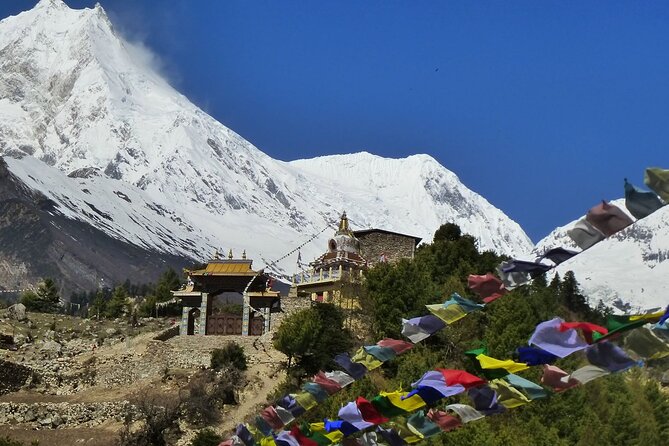
Day 5 is your real “you’re in the special area now” shift. You’ll cross the Dudh Pokhari Khola and walk into Salleri and Siridibas, then descend to a bridge over the Budhi Gandaki River. Shortly after, you reach Philim, which is described as relatively larger, and you’ll encounter the checkpoint for entering Tsum Valley where you show permits.
This checkpoint moment is more than paperwork. It shapes the vibe. Tsum doesn’t feel mass-tourism busy, and the route feels more like a guided access to a remote culture rather than a theme park trail.
After the checkpoint, you walk on to Lokpa, situated between the Budhi Gandaki and Siyar Khola. This is where the days start to feel slower—in a good way. You’re watching how people live when the region is still less exposed, and the walking gives you time to notice details like daily rhythms and the way trails connect homes to gompas.
Chumling and the Tsum community school: Tibetan Buddhist life on foot
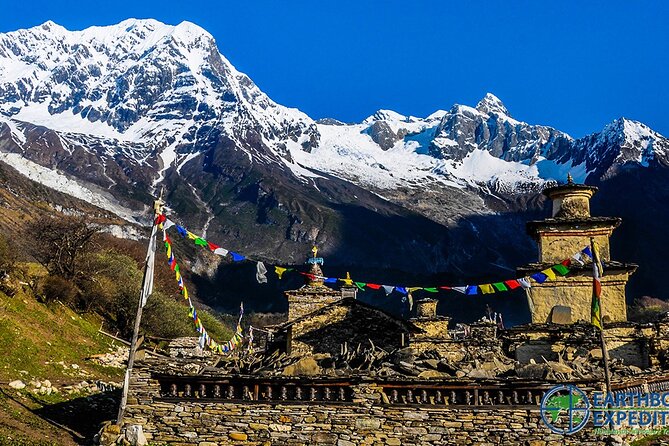
Day 6 is a culture-and-people day as much as a walking day. You trek toward the south bank of Siyar Kola, move through a forest, cross Lungwaa and Sarli Khola, and then work your way to Chumling. It’s a gradual ascend with repeated water crossings, so you’ll want steady pacing and good balance shoes.
Chumling’s special because it’s framed around Tibetan Buddhist community life. You’ll also notice the Ganesh Himal range in the east. That’s helpful for orientation: even when the day feels like a sequence of climbs and bridges, you’re still tracking mountains in the background.
The itinerary lists Chumling again for the next overnight as well, meaning you effectively get a “stay and soak it in” effect. That matters in a place like this. When you only pass through, you miss the small social moments. With more time, you can slow down and watch how the community school connects to village life (the plan explicitly includes the Chumling school component).
Mu Gompa to Rachen Gompa: monastery days with monks and nuns
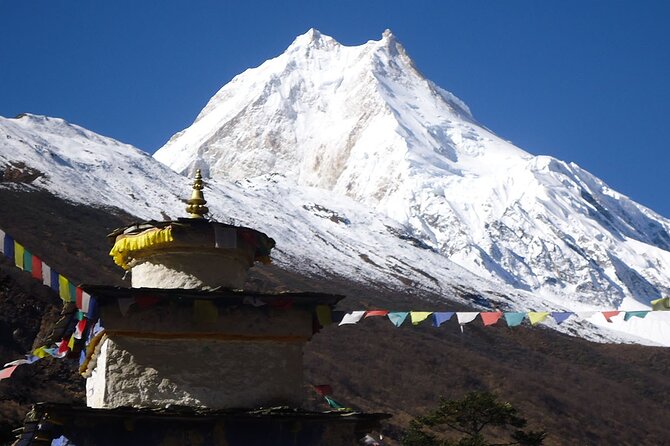
As you push deeper, day 9 brings Mu Gompa. You ascend after breakfast, and Mu Gompa is described as the highest point in the valley. It was established by Drupa Rinpoche, a Bhutanese lama who meditated in nearby caves. If you like meaningful religious geography, this is exactly that: you’re not just visiting a building, you’re walking into a place tied to practice.
The day also gives you a direct sense of atmosphere: you may see monks meditating and praying in the monastery. Then you spend the night at Mu Gompa, which means the surrounding views can feel very clear from the high setting.
Day 10 continues the monastery chain. You trek to Bursi and visit the Rachen Gompa, described as one of the oldest monasteries in the area. There’s also a nunnery with nuns residing there, plus lodging for travelers. Even if you don’t stay inside, it’s a rare chance to witness how different religious roles live in the same spiritual ecosystem.
On the way you’re also moving between villages like Kalung and Bhajyo, so you’re not treating the trek like a checklist of buildings. You’re combining worship sites with the human-scale travel of village-to-village footpaths.
Leaving Tsum for Manaslu at Deng: the “big trek” begins
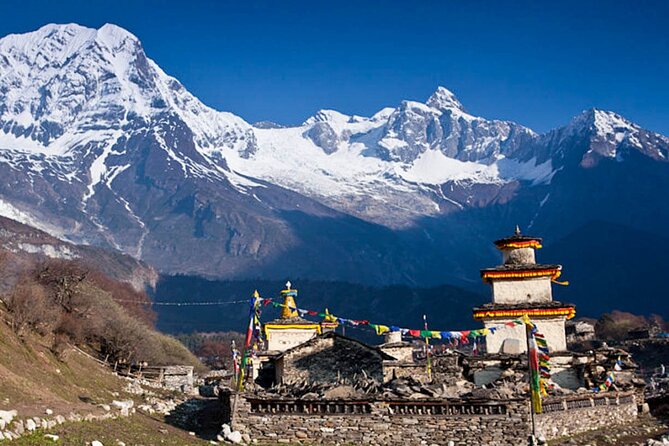
Day 12 marks your farewell to Tsum Valley. You descend from Chumling to Deng, leaving behind Lokpa and crossing the bridge over the Budhi Gandaki. Then you join the Manaslu Circuit route.
This is where you start feeling the scale shift. The trail still has culture and mani walls, but the bigger scenery takes over. The walking day includes passing Buddhist stone arches, and the valley travel gives you more open sightlines as you head west.
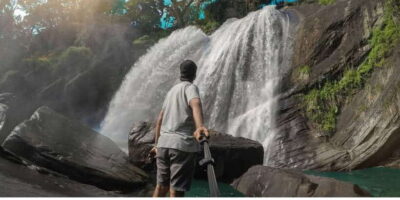
Day 13 continues the Manaslu rhythm. You cross over the Budhi Gandaki River again and pass a large waterfall and a wooden bridge out of the canyon. You’ll walk through forests that are described as silent and serene, and you reach Ghap for mani walls, then continue to Namrung.
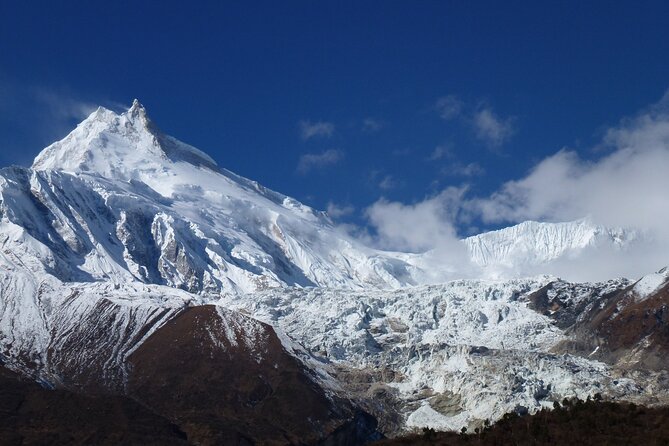
Then the trail opens into the villages that most people associate with the Manaslu Circuit experience: Lihi, Sho, Lho, Shyala, and Sama. Reaching Sama on day 14 is a big moment because you’re surrounded by major mountain presence, including Manaslu, plus nearby peaks like Himal Chuli and Ngadi Chuli referenced in the plan.
Sama, Samdo, and the pass route preparation
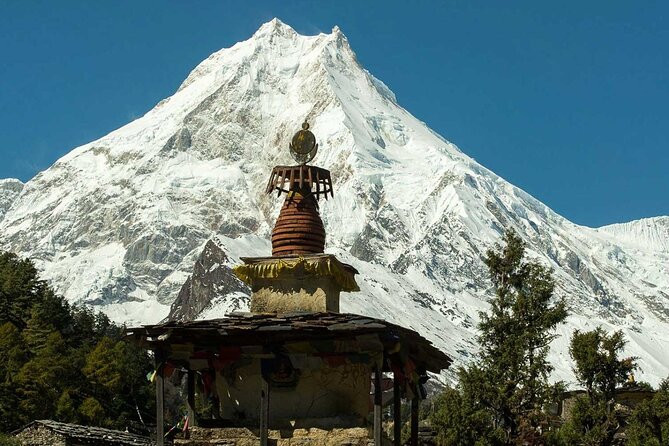
Sama gets a rest day on day 15, and that’s a smart scheduling choice. You can wake later, eat a relaxed breakfast, and interact with Sherpas to learn about traditions. The day also includes village exploring, including long mani walls with Buddhist texts.
You’ll also visit Pungyen Gompa on a ridge for ancient gompa atmosphere and glacier views. This matters because it gives you a “preview” of what’s coming next. You start to understand the high route visually, not just as a description of future altitude.
Day 16 shifts toward the Tibetan border zone. You descend to the Budhi Gandaki River, cross a bridge, and follow a trail closer to the border. The plan highlights juniper and birch forest leading to Kermo Kharka, then a wooden bridge to a vantage point and eventually Samdo in about four hours.
Samdo is where the mood changes. The trail starts to feel more weather-aware. You’ll still have that cultural texture—mani walls, village details—but it’s less about spotting everyday life and more about reading the mountains and preparing for the high pass day.
Larkya La and Karcha La: the serious walking days
Day 17 is your first major altitude commitment. You ascend to Larkya La and pass through terraced fields, with old mani walls and stone arches along the way. Then you cross a wooden bridge and pass juniper forestation. The plan specifically calls out a view of Larkya Glacier before you reach Larkya Phedi for the night.
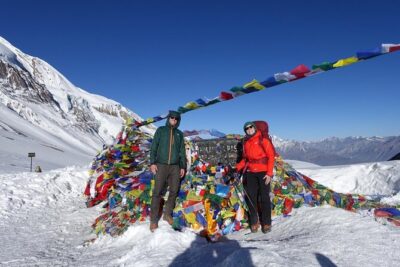
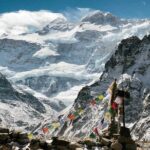
This night matters because day 18 is the big payoff day. The trail starts with a gentle climb to the moraine and then becomes challenging while you stay on the moraine to a ridge where you can see prayer flags at Larkya La. The route description notes slippery sections and rougher moraine terrain, so the main lesson is simple: slow down and place your steps deliberately.
From the pass area you descend to steep slopes and through grass moraine, then you eventually reach a meadow and spring, followed by a path of settlements leading to Bimthang for the night.
Day 19 takes you toward Karcha La, with a gentle climb through paddy fields and then a descent through fig trees and rhododendron forest to Tilje. This is the last “high feeling” day before you transition back toward Kathmandu.
Gear, comfort, and what’s actually included
This trek is well set up for cold mountain nights. You’ll have use of a down jacket and sleeping bag while trekking, plus a duffle bag. That’s a real value because buying or renting those items at your destination can be expensive or annoying.
You also have a team: one highly experienced guide plus a porter, with a porter ratio listed as 1 porter for 2 people. The package includes porter food, accommodation, salary, equipment, and accidental insurance for staff. That reduces the mental load for you. Your job stays focused on walking and staying warm, not managing logistics.
On comfort expectations: hot shower during the trek is not included, and cold drinks, bottled or boiled water, snacks, and personal expenses are also not included. The itinerary includes breakfast, while lunch and dinner are shown as included in the details but meals beyond breakfast are also described in a way that can be inconsistent. I’d treat that as a “confirm at booking” item so you don’t get surprised.
Finally, the trek mentions a first aid medical kit, and the trip is for travelers with moderate physical fitness.
Price and value: is $1,495 worth it?
At $1,495 per person for ~21 days, the value is mainly in what’s bundled rather than what’s left for you to organize. You get:
- Private vehicle ground transport, including airport transfers
- Three nights in Kathmandu at a 3-star hotel in Thamel
- Lodging during the trek described as best available twin sharing lodge-to-lodge
- Guide and porter support with staff insurance and coverage
- Manaslu and Tsum special trekking permits plus Annapurna and Manaslu conservation fees
- Trek gear use: down jacket and sleeping bag
- Taxes and office service charge, plus a trekking map and trip achievement certificate
Where the cost can feel “tight” is what you still manage yourself: travel insurance, international airfare, and the Nepal entry visa cost, plus personal drinks/snacks and personal trekking equipment. If you already own the basics for trekking, the main savings are that the tricky pieces are handled for you (gear use, permits, transport, staff).
For the route itself, you’re paying for access and rarity. Tsum Valley required a restricted-area approach until 2008, and in practice you’ll see permit checkpoints and limited exposure. That’s hard to replicate on your own without a local team.
Who should book this trek, and who should rethink it
You’ll love this trek if you want a balance of culture and high mountain walking and you don’t mind that the trail is sometimes about patience, not speed. If you like monastery visits that connect to real daily life, Tsum is the star here. If you want one big dramatic view day after another, the Manaslu Circuit section will satisfy you.
Consider rethinking if you hate slippery moraine terrain, long stair-step river climbs, or if you feel uncomfortable without hot showers. The trek is described for moderate physical fitness, which is a helpful baseline, but the pass days still require care and stamina.
This is also a good choice if you prefer smaller-group trekking. With a max of 15 travelers, you should have more breathing room in villages and fewer crowded meal moments.
Should you book this Tsum Valley and Manaslu trek?
Yes, if your ideal Himalaya trip includes quiet places with real cultural texture plus a serious pass journey. The design makes it easier to focus: permits, transport, and cold-weather gear are handled, and your guide support should keep the route feeling organized rather than chaotic. The fact that the route centers Mu Gompa, Rachen Gompa, and mani-wall village walking gives you something deeper than scenery alone.
Before you commit, do two quick checks. First, confirm your full meal plan for lunch and dinner (because the inclusions/exclusions section is inconsistent). Second, plan for no hot shower and bring the personal items you’ll want for water and snacks, since those are not included.
If those boxes are fine, this is a strong pick for a memorable Tsum-to-Manaslu trekking story.
FAQ
What is the duration of the trek?
The trek is listed as about 21 days.
Where does the tour start and when?
It starts in Kathmandu, with a listed start time of 7:00 am.
How many nights do you stay in Kathmandu?
You get three nights in Kathmandu, with breakfast included, in a 3-star category hotel in Thamel.
Are trekking permits included?
Yes. The package includes Manaslu and Tsum Valley special trekking permits and Annapurna and Manaslu conservation fees.
Do they provide trekking gear like a sleeping bag?
Yes. Down jacket and sleeping bag use while trekking are included, along with a duffle bag.
What accommodation style do you get during the trek?
You stay in best available twin sharing lodge-to-lodge accommodation during the trek.
Is pickup included?
Yes. Pickup offered and all ground transportation by private vehicle including airport transfers are included.
Who handles the trek logistics and do you get porters?
The trek includes one experienced guide and porter, with a porter ratio of 1 porter for 2 people, and their food, accommodation, salary, equipment, and accidental insurance are included.
Is lunch and dinner included?
Breakfast is included. Lunch and dinner are shown in the details as included, but meals are also mentioned in a way that can be confusing, so it’s worth confirming at booking what’s covered each day.
Is there free cancellation?
Yes. You can cancel up to 24 hours in advance for a full refund. If you cancel less than 24 hours before the start time, the amount paid isn’t refunded.